Cut, Paste, Remember: How Scrapbooking Became the Collector's Most Intimate Archive
Somewhere between your camera roll and your cloud storage, there are thousands of moments you'll probably never look at again. Birthdays, road trips, the random Tuesday afternoon that somehow felt significant — all of it sitting in a folder you'll maybe open once a year, if that. For a lot of people, that's fine. But for a growing community of collectors and memory-keepers across the US, it isn't nearly enough.
Scrapbooking — yes, that scrapbooking — is having a genuine moment. And it looks almost nothing like what your aunt used to do at the kitchen table with a Cricut machine and matching cardstock borders.
Not Your Mom's Scrapbook
The resurgence isn't driven by nostalgia for the craft's early-2000s peak, when Michael's and Hobby Lobby aisles were packed with themed sticker sheets and die-cut alphabets. What's pulling people back in now is something rawer. Collectors in their 20s and 30s are approaching scrapbooks less like decorative albums and more like personal archives — chaotic, honest, and deeply intentional.
Maya, a 27-year-old from Portland who started scrapbooking during the pandemic, puts it bluntly: "I had like 4,000 photos on my phone and I felt nothing when I looked at them. I printed out thirty, glued them into a notebook with some ticket stubs and a receipt from a diner I loved, and suddenly I could actually feel that trip again."
That shift — from volume to curation, from passive storage to active meaning-making — is at the heart of why scrapbooking resonates so strongly right now. It demands you make choices. What gets included? What gets left out? How do you arrange the story of a weekend, a relationship, a year? Those aren't just design questions. They're existential ones.
The Tactile Argument
There's a reason so many hobbyists in the scrapbooking community talk about the physical act of making a page before they talk about the finished product. Cutting out an image, choosing where it sits on a spread, layering it with a handwritten note or a dried flower from a hike — it's slow in a way that feels almost countercultural.
Jordan, a 31-year-old collector from Austin who runs a small online community for what he calls "lo-fi scrappers," describes it as a form of active memory consolidation. "When I'm building a page, I'm not just filing something away. I'm actually thinking about what happened, what it meant. It's meditative. My phone never gives me that."
Research backs up the intuition. The act of physically handling objects and images tied to personal experiences has been linked to stronger memory encoding and emotional processing. For a generation that grew up with smartphones but increasingly questions their relationship with screens, there's something quietly radical about sitting down with scissors and a glue stick.
Imperfection as Aesthetic Philosophy
One of the most interesting things about the current scrapbooking revival is its deliberate rejection of polish. The Pinterest-perfect spreads with color-coordinated washi tape and matching fonts still exist, but they're not driving the cultural conversation anymore. What's getting shared in Discord servers and niche subreddits tends to look more like a teenager's diary from 1994 — torn edges, overlapping layers, handwriting that doesn't stay on the line.
This isn't sloppiness. It's a statement.
"Perfect scrapbooks look like ads," says Dani, a 24-year-old from Chicago who documents her life in what she calls "ugly books." "I want mine to look like me. Like my actual brain. Messy and referential and sometimes embarrassing."
For collectors who spend a lot of time thinking about authenticity — whether they're hunting for vintage records, annotating books, or building any other kind of personal archive — that logic lands immediately. The value isn't in the object looking good. It's in the object being true.
Community in the Margins
Like most collecting hobbies worth caring about, scrapbooking has developed its own rich community infrastructure. Beyond the big platforms, there are tight-knit groups organized around specific aesthetics (junk journaling, ephemera collecting, mixed media), specific life chapters (grief books, travel books, "year in review" annuals), and specific material philosophies (thrift-only supplies, hand-lettering only, no digital printing).
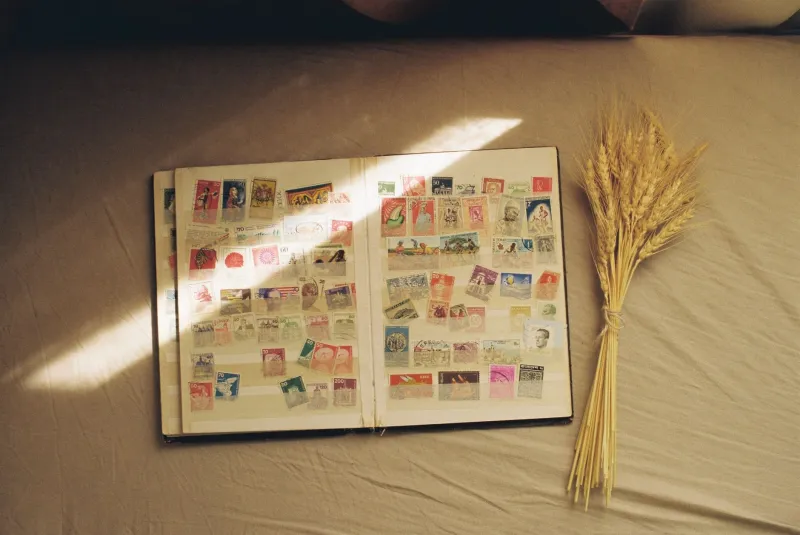
Swap meets — both online and in-person — have become a major feature of the scene. Collectors trade vintage postcards, magazine clippings, packaging from old products, foreign stamps, and other paper ephemera that might find its way into someone else's archive. It's a reminder that scrapbooking, at its best, is a social practice as much as a solitary one.
"I got a piece of sheet music from a stranger in Ohio," Maya says, "and I have no idea what the song is, but I stuck it in my travel book because it felt right. Someone else's memory is now part of mine. That's kind of beautiful."
Starting Without Overthinking It
If you're curious but intimidated, the good news is that the barrier to entry is genuinely low. You don't need a dedicated craft room or a $200 supply haul. The people doing the most interesting work in this space tend to operate with intentional constraints — one notebook, whatever's on hand, no rules about what belongs.
A few things that actually help:
- Print your photos. Even a cheap home printer or a drugstore print order changes everything. Physical images force decisions in a way that digital files never will.
- Save your ephemera. Ticket stubs, packaging labels, receipts, napkins with notes on them — keep a small box or envelope for the physical debris of your life. You'll be surprised how much of a story it tells.
- Don't wait for the right supplies. A composition notebook and a glue stick is a scrapbook. Seriously.
- Embrace the bad pages. Some spreads are going to be ugly. That's the whole point. They're still yours.
Why It Matters
At its core, the scrapbooking revival is about the same thing that drives most collecting impulses: a desire to hold on to something real in a world that moves too fast and forgets too easily. Digital photos don't age. They don't yellow or curl at the corners or smell like the basement where your grandmother kept hers. They don't require you to sit with them.
A scrapbook does. It asks for your attention, your editing eye, your handwriting, your weird little stickers. In return, it gives you something no cloud service can replicate — a physical object that carries your actual life in it, imperfect and irreplaceable.
That's not a small thing. That's the whole thing.